
As a character Phinella Martin, Lady Detective is not well-known – her cases were never published in book form – but just over a century ago she made hundreds of appearances in Woman’s Weekly. Precise details of the authorship of individual tales are not known but three of Margery’s closest family members were involved in the creation of the character and the launch of this long-running series.
Most of the biographical details of the Allingham family mentioned below are taken from the book “Fifty Years in the Fiction Factory: The Working Life of Herbert Allingham” by Julia Jones (Pleshey: Golden Duck [UK] Ltd, 2012).
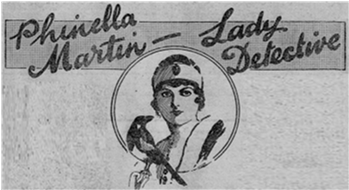
Before the First World War Margery’s parents, Emily and Herbert, were well-established writers specialising in popular fiction, mostly short stories and serials for magazines, comics and story papers. In August 1915 Emily’s sister, Maud Hughes, joined the editorial staff of Woman’s Weekly and one of her first acts on taking up her post was to commission a series of stories featuring a female detective.
The first of these was published on 2nd October 1915 and “Phinella Martin – Lady Detective” ran for the best part of five years, with the last part appearing on 24th July 1920. The series featured in almost every issue during this period although the exact number of stories is difficult to ascertain. Issues of Woman’s Weekly from this period are very scarce – even the British Library does not have a full set available – but it seems probable that Phinella made a total of 246 appearances. There was a short hiatus of six weeks during February-March 1920 but otherwise it is likely that she appeared in all other issues.
Woman’s Weekly, which had launched in 1911, was published by the Amalgamated Press. (Although Emily and Herbert did not write for Woman’s Weekly prior to Maud’s arrival they had during the previous decade become regular contributors to many of the firm’s other periodicals.) For its first few years the magazine was a conventional blend of fashion, cookery, childcare and home management. There was fiction but this tended to be unexceptional stories of romance or domesticity. However by August 1915, a year into the First World War, the role of women was changing, giving them new aspirations and broader horizons.
There were more job opportunities, including openings in the publishing industry, and at about the same time that Maud joined Woman’s Weekly there was also a new female editor, Winifred Johnson. Under their leadership the magazine was reinvigorated and became a more dynamic publication, produced by women for women. A series featuring a strong, independently- minded lady detective was just what the new look Woman’s Weekly needed.
It is perhaps only natural that Maud would take advantage of the expertise available from her sister and brother-in-law and ask them to write for the periodical. Since the series was published anonymously, and no relevant publishing records exist, authors cannot be attributed to individual pieces of work but Emily is accepted as the writer of many of the early stories and as being instrumental in the creation of the character. At this time wife and husband would occasionally collaborate, sometimes with Emily taking the main writing role and Herbert assisting. So he may too have also contributed in some capacity to the Phinella Martin stories.
There is also the possibility that Maud herself made some creative input to the series, perhaps suggesting ideas to others or even participating in the writing herself. However, Phinella Martin would have been a ‘house’ character owned by the Amalgamated Press and it is almost certain that other writers took on authorial responsibilities later in the run.
Some critics and commentators make the blanket assertion that the Phinella Martin stories were all from the pen of Emily Allingham but that is an oversimplification. Some of the later stories would be more accurately described as ‘based upon’ or ‘featuring’ the character created by Emily Allingham.
After a little less than four years in post Maud moved on, taking up the editorship of a new magazine, Picture Show, which launched on 3rd May 1919. With her leaving Woman’s Weekly the Allingham’s association with the periodical also came to a close.
It was not, however, the end of the line for Phinella Martin whose investigations continued in the paper for another year and so the stories published in late 1919 and 1920 would almost certainly have been written by other hands.
To begin with the series title was generally “Phinella Martin — Lady Detective” but this was not used every week. Indeed sometimes there was no indication that a story was part of the series, with the lead character’s name neither included in the title nor any accompanying heading. About halfway through the run greater consistency was introduced and the series name, shortened to “Phinella Martin — Detective”, was used each week.
A new writer may have been at work — one can only speculate about the authorship — when for eleven weeks, starting on 24th April 1920, the series became “Secrets of Harridges”. During this period Phinella joined the staff of ‘Harridges’ (the name is a rather clumsy amalgam of ‘Harrods’ and ‘Claridge’s’) as the chief store detective. Whilst at the shop she worked incognito using the alias Pamela Murray and for much of this time she battled against an organised crime syndicate calling itself ‘The Shop-Lifting Trust’.

During her stint at Harridges the following story headings were used:
Phinella Martin joins the staff of the largest store in the world.
Phinella Martin behind the scenes in the biggest store in the world.
Phinella Martin’s investigations as staff detective for Harridges’ stores.
For the final three weeks of its run the series title reverted to “Phinella Martin — Detective”.
The Phinella Martin stories
When the series opens Phinella Martin is already an established detective who receives clients in an exotic consulting room, furnished entirely in black and white, known as the Magpie Room. The first few stories carry a heading to this effect, generally a variation on “Secrets Told in the Magpie Room.” The room may be so called both on account of the colour scheme and from the fact that it is home to an outspoken and loquacious bird of the species. This opening paragraph, from an early story, is typical of how the scene is set:
Phinella Martin sat in the famous magpie room, her beautiful face puckered by frowns. The room which had held so many secrets, and in which so many mysteries had been solved by the wonderful lady detective, looked more black than white this afternoon, as if the weird magpie furniture and hangings reflected their owner’s depression. The shadow of the black ottoman seemed to darken the snowy white cushions, and the white Egyptian figures on the black wallpaper seemed almost absorbed by the dark background.
Many of the early stories involve domestic problems, particularly dramas of love and jealousy. Subheadings include: ‘A story of true and false love,’ ‘A splendid story of love and crime,’ ‘A Human Drama’ and ‘Phinella Martin solves a mystery and brings two lovers together.’ This commitment to the course of true love is emphasised in the opening story “The Second Miss Phelps” in which she charges her client no fee, declaring, “Love is more than money, and in this case, I’ve done it for love.”
For the first year of the series Phinella has a “trusted assistant”, Sybil Osborne, who is employed in both orthodox and less orthodox fashions. Whilst Phinella is with a client, Sybil conceals herself in a lift adjoining the consulting room and makes notes of the interview. The purpose of this clandestine activity is not entirely clear but presumably it gives Phinella another perspective on the case, unbiased by actual interaction with the client. Sybil also helps in other routine ways but she does not herself function as a detective.
The other important recurring character is Chief Inspector Staines of Scotland Yard whom Phinella describes as an “old friend”. He really is just that — there is no suggestion of romance. He overlaps with Sybil for a while but, whereas she is phased out, he features in almost every story until the end of the run. As the series progresses stories are less likely to open with a consultation in the Magpie Room than with Staines seeking Phinella’s assistance and expertise when faced with a particularly difficult case.
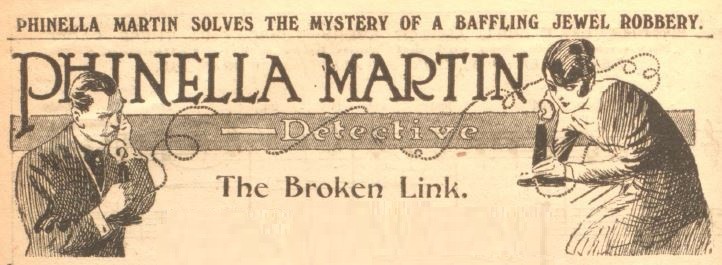
Phinella must be a woman of independent means as she seems to receive little in the way of remuneration for her work. Fees are sometimes waived altogether or a proportion of them is donated to charity. Her involvement in Staines’s cases appears to be unofficial — she is not employed in any capacity by Scotland Yard — and the implication is that she is helping a friend purely out of altruism.
At between 2,000 and 3,500 words, the stories are quite short and do not lend themselves to elaborate plots or detailed characterisation. As might be expected, given the longevity of the series, the range of crimes investigated is very wide and includes a standard mixture of murder, theft, extortion, forgery, blackmail and swindling. The series opens during the First World War and this provides a backdrop to stories featuring spies, stolen military secrets and other acts of espionage.
As a detective Phinella is cool, calm and competent enough but by no means exceptional. She is an adept at disguise and is able to play female roles covering the full gamut of age, class and occupation. She is an expert at ciphers, which she uses frequently when communicating with Staines, and also at lip-reading which was still something of a novelty at this time although other female detectives were proficient in the art before her.
Most plots hinge upon a single clue with a resulting deduction but in many of her cases the outcome is anticipated by the reader, as Phinella is wont to make pronouncements about guilt and innocence based upon her feelings or the physical appearance of a character.
The final story contains no resolution and no indication that it is Phinella’s last recorded case. The career of a female detective of this era was often brought to an end by the ‘marriage plot’. A romantic attachment might develop during the course of a series or be hastily contrived towards its end but the final result would be the same: she would swap her life as a detective for one of wedded bliss.
Phinella is spared this. Her relationship with Staines is genuinely platonic and she has no other admirers of any consequence. She would therefore be able to fight another day although for Phinella that day never dawned.
 margeryallingham.org.uk